
编织袋清洗机供应商
在Towobo上找到经认证的B2B编织袋清洗机供应商——PP编织袋、FIBC集装袋及回收拉菲草包装完整粉碎清洗造粒生产线。
没找到需要的产品?
Processing woven PP bags — the washing sequence
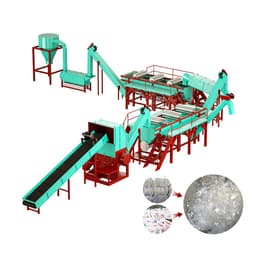
Recycling woven PP bags involves several distinct processing challenges. Woven bags are difficult to shred uniformly — the interlocked raffia strips catch in standard shredder teeth. Specialist wet shredders or granulators with appropriate cutting geometry are needed to reduce the bags to manageable flake sizes (typically 30–60mm). Contamination in used woven bags can include cement dust, fertiliser residues, soil, sand, and food materials — varying significantly by end-use application. A typical woven bag washing line comprises: a shredder or wet granulator; a pre-soak or trommel wash for initial loose contamination removal; a high-capacity friction washer designed for the fibrous flake; a rinse tank; a centrifugal dryer; and thermal dryer. For cement or mineral-contaminated bags, additional stages including a sink-float tank and a second friction wash stage may be needed. The PP raffia flake produced after washing and drying is fed to a pelletising extruder — the compounding step re-agglomerates the fibrous material into uniform pellets suitable for downstream processing.
Key design considerations for woven bag washing machines
Friction washers in woven bag washing lines must handle the fibrous, lightweight nature of shredded PP raffia. Insufficient rotor speed and clearance causes poor washing; too aggressive a design breaks fibres and generates fines. The friction washer design — rotor diameter, rotor speed, internal liner material, and clearance between rotor and liner — should be confirmed with the machine manufacturer for the specific input material. Water consumption: woven bag washing is water-intensive, particularly for cement or mineral-contaminated input. A closed-loop water treatment system with settlement and filtration is essential. Confirm water consumption (m³/tonne of plastic processed) and wastewater quality with the supplier. Throughput ranges: small woven bag washing lines typically process 300–800 kg/hour; medium lines 800–2,000 kg/hour. The market for recycled PP from woven bags includes woven bag re-manufacturers, plastic pipe producers (reinforced applications), injection moulders, and fibre producers.
Frequently asked questions
What is the output quality from a woven bag washing line?
A well-configured woven bag washing line should produce PP flake or pellets with contamination below 500 ppm for standard applications (woven bag re-manufacture, pipe compounding) and below 200 ppm for more demanding applications. Cement dust is particularly challenging to remove completely — if cement-contaminated bags are a significant part of your input stream, specify additional washing intensity (extra friction washer stage, hot water rinse) and confirm achievable contamination levels in the supplier's process guarantee.
Can the same washing line handle both woven bags and flexible film?
Some manufacturers offer multipurpose lines designed to handle both woven bags (PP raffia) and flexible film (LDPE/LLDPE). In practice, the two materials have sufficiently different processing requirements that purpose-designed separate lines generally give better results. If a multipurpose line is planned, confirm with the supplier the output quality achievable for each material type and any changeover time or settings adjustment required when switching between materials.
Where can I source woven bag washing machines?
Chinese manufacturers specialising in plastic recycling machinery are the primary source for woven bag washing machines globally. Manufacturers based in Zhangjiagang, Changzhou, and Qingdao in China produce washing lines specifically for PP woven bags and raffia. European manufacturers such as Herbold (Germany) and Previero (Italy) produce equivalent equipment at a higher price point. Request a process test with samples of your actual input material — the contamination type and level vary significantly and affects machine performance.
What pre-sorting is needed before a woven bag washing line?
The minimum pre-sorting for a woven bag washing line is removal of non-PP materials — HDPE liners, paper labels, metal wire closures, and any non-plastic contamination. Manual sorting or magnetic separation (for metal removal) is typically the first stage before shredding. For cement bag recycling specifically, emptying and shaking out loose cement before the shredder significantly reduces the washing load and improves output quality. The more pre-sorting done at the input stage, the better the washing line performance.
寻找经过验证的批发供应商?立即浏览列表。
在Towobo上查找编织袋清洗机供应商towobo 上的供应商
暂无供应商上架此产品。请在下方告诉我们您的需求,我们会为您寻找合适的供应商。

请求报价
告诉我们您的需求,从多个认证供应商获取报价
为什么请求报价?
- 从多个供应商获取有竞争力的价格
- 根据您的要求获取定制报价
- 直接与认证制造商联系
- 通过我们的匹配服务节省采购时间
经常采购?
免费创建买家账户,收藏供应商、直接联系他们并享受付款保障。