
硬质与软质塑料清洗线供应商
在Towobo上找到经认证的B2B硬质与软质塑料清洗线供应商——可在同一组合处理流程中同时处理硬质塑料(HDPE、PP)和软质薄膜(PE、LDPE)的多功能生产线。
没找到需要的产品?
Rigid vs flexible plastic — different processing requirements
Rigid plastic (HDPE, PP, PET) and flexible plastic film (LDPE, LLDPE) have fundamentally different physical characteristics that require different machine designs. Rigid plastic: higher bulk density (300–500 kg/m³), fractures cleanly under granulation, flows freely through conveyors and washers, and is relatively easy to process. Film plastic: very low bulk density (20–80 kg/m³ for loose flake), tangles in rotating equipment, requires wet cutting (wet granulator) rather than dry crushing, and needs high-volume handling equipment sized for volume rather than weight. Density-based separation (float-sink): both PE film and PP/HDPE rigid plastic float in water — density separation alone does not separate rigid from flexible. Hot wash is more commonly needed for post-consumer rigid plastic (bottles with adhesive labels) than for industrial film, but agricultural film may need it too. Because the processing requirements differ, a combined rigid/flexible line is typically a compromise — it may not achieve the optimal output quality for either stream that dedicated purpose-designed lines would. The practical question is whether the available input volume and economics justify two separate dedicated lines or whether a combined approach is more appropriate.
Combined washing line design — when it makes sense and how it works
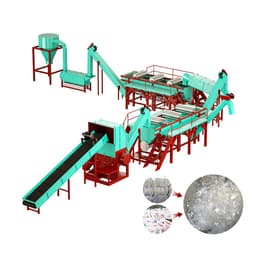
A combined rigid/flexible plastic washing line makes commercial sense when: input volumes are too low to justify two fully independent lines; the operator processes mixed post-consumer waste where separating rigid and flexible before washing is not practical; or the operator wants the flexibility to switch between different input streams. Typical combined line configurations: a two-stream approach with a single shared washing section fed by separate size reduction stages (a granulator for rigid and a wet granulator for film); or a sequential approach where the line is configured for flexible film in the first production run and reconfigured (by changing screens and settings) for rigid plastic in a second run. The shared washing stages — friction washer, float tank, rinse tanks — are largely compatible between rigid and flexible if sized correctly. Dewatering and drying require different handling for film vs rigid — centrifugal dryers for rigid run at higher speeds with tighter screen apertures, while film dryers need lower speed and wider screens to prevent film from blocking. Request a clear layout from the supplier showing how the combined line handles both material types and what the changeover procedure is.
Frequently asked questions
Is it better to invest in one combined line or two separate dedicated lines?
Two separate dedicated lines will consistently produce better output quality for each material type than a single combined compromise line. If your input volume justifies two lines, this is the preferred approach. A combined line is appropriate for lower-volume operations, startup recyclers testing market demand, or operations where the ratio of rigid to flexible input is uncertain and flexibility is valued over optimal quality. Discuss your specific input volume and target output specification with machinery suppliers to get comparative cost and output quality estimates for both approaches.
Can rigid and flexible plastics be pelletised on the same extruder?
In principle, both HDPE rigid pellets and LDPE film pellets can be produced on the same single-screw extruder by changing the temperature profile and screw speed settings. In practice, a complete material changeover (flushing the screw and barrel, adjusting temperatures) takes time and wastes material. For operations processing significant volumes of both materials, two separate extruders or at minimum a twin-screw compounder with high flexibility is more practical. Confirm the changeover procedure and material flushing requirements with the pelletiser supplier.
What is the market for mixed rigid/flexible recycled plastic output?
Mixed HDPE/PP/LDPE pellets or flake — produced by a line that does not fully separate material types — have limited applications. Most recycled plastic buyers specify single-polymer material (rHDPE, rPP, rLDPE) because mixed polymer content reduces the mechanical properties and processing consistency of the output. Mixed plastic compounds are used in injection moulded non-structural products (flowerpots, outdoor furniture, street furniture) and wood-plastic composite panels, but command lower prices than mono-material recycled pellets. If your target customers need mono-material output, invest in sorting capability upstream or dedicated processing lines.
What throughput should I plan for a combined rigid/flexible washing line?
Size the combined line based on the peak throughput of whichever stream (rigid or flexible) will be processed in the highest volume. Because flexible film has much lower bulk density than rigid plastic, the volumetric handling capacity of conveyors, tanks, and dryers must be sized for film rather than rigid. A combined line rated at 800 kg/hour for rigid plastic may only process 400–500 kg/hour of film due to volumetric limitations. Confirm the throughput specification for each material type separately when requesting a quotation.
寻找经过验证的批发供应商?立即浏览列表。
在Towobo上查找混合塑料清洗线供应商towobo 上的供应商
暂无供应商上架此产品。请在下方告诉我们您的需求,我们会为您寻找合适的供应商。

请求报价
告诉我们您的需求,从多个认证供应商获取报价
为什么请求报价?
- 从多个供应商获取有竞争力的价格
- 根据您的要求获取定制报价
- 直接与认证制造商联系
- 通过我们的匹配服务节省采购时间
经常采购?
免费创建买家账户,收藏供应商、直接联系他们并享受付款保障。